SIRS, Sepsis & Septic Shock


DEFINITION
See classifications below
See also Shock.
top D I A B M I M home


INCIDENCE
Septic shock biggest cause of death in intensive care settings.
At risk:
- pts with IDCs, prosthetic valves, on immunosuppression, and in intensive care.
-->50% mortality.
Immunocompromised pts
- are at special risk and may require special investigations.
top D I A B M I M home


AETIOLOGY

Common sources
Pulmonary
Urinary / IDC-related.
IV lines, esp CVP
Soft tissue infections
Acute pancreatitis
Reperfusion injury

Surgical Associations
Anastomotic leak (often at 4-8 days)
Biliary, especially if obstructed
Urinary, with obstruction
Collections / abscesses
Infected prostheses (eg valves, hips)
Necrotic tissue
Ischaemic gut
Ruptured aorta
Major haemorrhage
Trauma
top D I A B M I M home


BIOLOGICAL BEHAVIOUR

Classification

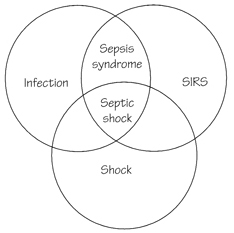
Venn diagram:
Sorry, Picture Unavaliable

Spectrum of the 'sepsis syndrome':

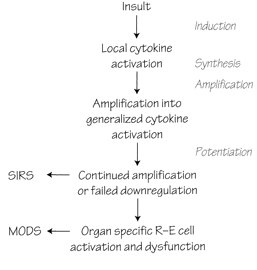
1.  Systemic Inflammatory Response Syndrome (SIRS)
- pyrexia > 38 or hypothermia < 36.
- tachycardia (>90bpm, not B-blocked)
- tachypnoea (>20); or PCO2 <32 mmHg
- WCC >12 or <4

2.  Sepsis
- SIRS and a documented source of infection

3. Severe Sepsis

- sepsis with evidence of altered organ perfusion; eg:
--> CVS: lactate >1.2mmol/L or SVR <800dyne/s/cm3
--> Resp: PaO2 <9.3kPa (70mmHg)
--> Renal: output <120ml over 4hrs.
--> CNS: GCS<15 in absence of sedation / neuro lesion.
- NB: look for any clinical evidence, not just these parameters

4.  Septic Shock
- refractory hypotension (despite sufficient fluid resuscitation) in addition to the above.

5. MODS
More than one organ with altered function

Pathogenesis

A nidus of infection (eg pneumonia, peritonitis, cellulitis, abscess, others) allows the release of organisms into the blood stream.
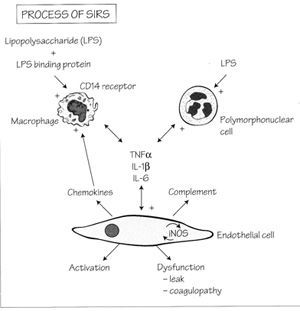
The organisms and the mediators that they induce, circulate.
Sorry, Picture Unavaliable

Organism toxins
Structural components, exotoxin, endotoxins.
Mediators:
PAF, bradykinin, complement, NO, histamine, PGs
- key cytokines are TNF-alpha, Il1, IL6 and IL8.
- primarily secreted by macrophages and monophytes
--> some anti-inflammatory mediators are also released, but excessive / prolonged upregulation leads to multiple organ failure.
- cascade of secondary mediators include leikotrienes, prostaglandins, and PAF; activate monocytes,
- result in cellular apoptosis, necrosis, nitric oxide synthetase induction and other host-destructive processes

Sorry, Picture Unavaliable

These agents (especially the mediators) have two principle effects:
i) myocardial depression
ii) vasculature resistance depression.

Anti-inflammatory mediators are also released by host in an attempt to maintain homeostasis
- IL-1B, IL-10, transforming growth factor-beta

Myocardial depression
Myocardial contractility is depressed via cytokines, leading to a right shift of the Frank Starling Curve.
Left and right ventricular ejection fractions are reduced.
--> heart responds with higher HR to boost CO
With very severe myocardial depression, CO is depressed leading to hypotension.

Vascular Resistance Depression
Vasodilation occurs in response to numerous agents above.
Systemic vascular resistance becomes severely depressed.
In combination with the myocardial depression, cardiovascular decompensation occurs and perfusion failure results.

Natural History
If septic shock persists, mortality is 50%.
Death results from unrelenting hypotension and multiple organ failure.
- when three or more systems have failed, mortality approaches 80-100%
--> other systems fail like a collapsing pack of cards.

Complications

Multiple organ system failure
with positive feedback to irreversible shock, unless rapid intervention is achieved
i) Resp Failure / ARDS:
- water-logged lungs due to extravasation of inflammatory fluid and cells
- ventilation difficult
- CXR often lags behind clinical findings, so be suspicious.
- superadded infection is possible.
ii) Heart failure - as above
- arrhythmia may exert an extra effect.
iii) Renal failure - common
iv) Others: brain, clotting,

Nosocomial Infection
Common, though multi-organ failure pts usually die with nosocomial infection rather than because of it
- the decision to give cultures must therefore be made carefully


top D I A B M I M home


MANIFESTATIONS

Symptoms
Local
The early features are subtle.
- may look well due to pink, well-perfused extremities.
Look for source of infection.
Fever, chills, features of septicaemia.
Early
Late
Restlessness, slight confusion
Decreases consciousness
Tachypnoea
Tachypnoea
Tachycardia
Tachycardia
Low SVR

High CO
Low CO
BP N or up
BP sys<80
Oliguria
Oliguria
Metabolic acidosis
Metabolic acidosis
Warm, dry extremities
Cold extremities
Note in latter stages pt may be indistinguishable from those with hypovolaemic shock.
- may be hypo or hyperthermic

Signs
Refer shock.
Tachycardia, tachypnoea and hypo/hyperthermia are all consistent with major sepsis.

top D I A B M I M home


INVESTIGATIONS
Refer shock.

Haematology
WCC is often <2 or >10.

Biochem
ABG may show metabolic acidosis
Acute renal failure is common.
LFT derangement may represent source (eg biliary sepsis) or developing organ failure.

Microbiology
Cultures are obligatory
- but only positive in up to 20% of cases
Send all suspect fluids eg sputum, urine, drain fluid, pus from wounds
- immediate gram-stain can aid antibiotic prescription.
Culture central lines
- consider fungal infection and send fungal cultures

Coags
Developing DIC may cause a low platelet count and elevated fibrin degradation products.

ECG
For ischaemia / arrythmia.

top D I A B M I M home


MANAGEMENT

Prevent it

- preop assessments should deal with septic foci
- prophylactic antibiotics should be given in surgery
- postop use physio and ensure early feeding, remove lines and tubes and treat early.

Recognise early

Move to HDU or ICU.
Once sepsis is advanced the outlook is bleak.

Aims:
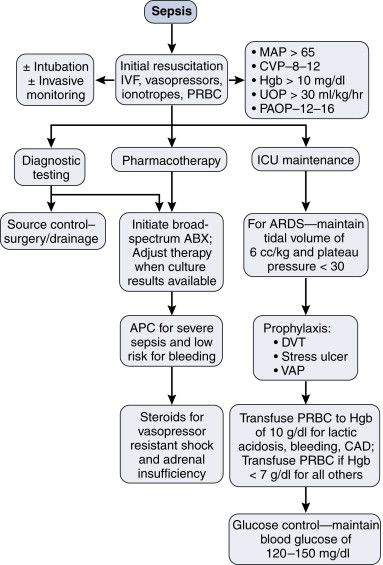
1) Resuscitate and Maintain Perfusion
2) Eliminate responsible nidus of infection;
- and early antimicrobial therapy
3) Interrupt pathogenic sequence.
4) Supportive care
- including specific treatments and adjuncts

image
(APC = activated protein C)
-controversial

Index of Managment
Maintain perfusion
Eliminate Nidus of Infection
Interrupt the Mediators
Daily Planning
The Deteriorating Patient

Maintain perfusion
Resuscitate immediately as per shock notes

1. Fluids
Maintain good perfusion
- remember uncorrected hypoxia activates the cytokine cascade
- crystalloid should be good enough.
- colloids are controversial: may stay in the intravascular space longer, but if the do leak, they will often worsen any oedema.
--> may need up to 10-12L of fluid in the first 24 hrs; but do not overload the patient.
--> titrated to endpoints, MAP >65 mm HG, urine,
-->CVP of 5-10 cmH20 and a urine output greater than 30ml/hr are reasonable guides to the adequacy of initial fluid resuscitation.

Also maintain Hb >100 g/L, and adequate CO (MAP > 60mmHg at the least).
- some clinicians advocate pumping CO up to supranormal levels, but use of inotropic agents to achieve this has no evidence basis from RCTs.

If hypotension / inadequate perfusion persist despite adequate fluid replacement and CVP monitoring then inotropic support is indicated.

2. Oxygen
Avoid hypoxaemia
--> High-flow O2, maintain sats >92%.

3.  Nutrition
These patints are catabolic and nutrition is essential for immune function.
Beware nosocomial infection compromising respiration, and use enteral nutrition to avoid this outcome.
- but avoid substrate overload, seldom should they receive more than 2000-2500kcal/day or 14-18g/day of nitrogen.

4. Vasopressors and Inotropes
When hypoperfusion persists despite adequate resuscitation.
Norepinephrine then vasopressing
Titrated to clinical endpoints and CVP 8-12mmHg.

Supportive care also includes ventilatory support, blood products, dialysis, glycemic control, nutrition, sodium bicarb, DVT prophylaxis and

Nidus elimination

1. Identify nidus of infection
- follow investigations above
- follow symptom clues closely, and perform a thorough septic screen.
--> beware the combination of obstruction and infection (eg biliary / renal) as this may be severe.

2. Surgical drainage
- with/without radiological guidance.
Remember the adage: pus somewhere, pus nowhere, pus under the diaphragm.

3. Antibiotics
As soon as possible, given on a best-guess basis, after cultures etc have been taken.
Limit treatment courses to 5-7 days
--> prolonged / prophylactic courses is detrimental as superinfection by fungi and antibiotic-resistant pseudomonas enterococci and staphylococci is encouraged.
--> high mortality and difficult to treat.
Importantly, review the antibiotics every day as cultures become available.
--> discuss with the microbiologist.
- think of fungi.

Pathogenic sequence
Work is underway to interrupt the endogenous mediator cascade.
- monoclonal antibodies vs TNF, IL-1 and endotoxin have been tried.
--> have generally had no effect on mortality to date.
Protein C therapy shows promise.
However if one mediator is blocked, the others soon compensate for its absence
--> hence it seems unlikely these treatments will ever replace the above two basic principles
--> time will tell how effective they will be.

The Daily Plan
Each day formulate a management plan for these patients
- list clear positive decisions
--> aim for progress through attention to detail.
Involve physiotherapist for chest care.
Provide DVT prophylaxis
Remove drains as soon as possible, unless vital, in which case secure it.

The Deteriorating Patient
Detect the deteriorating patient
Undulating pyrexia
Increasing WCC
Tachycardia
DIC
Metabolic acidosis
Multi-organ failure
Or may simply fail to progress.
Act promptly and get senior ICU help

MODS

1. A disease unanticipated by evolution
.
- physiological compensations may be undesirable.
- 'dysfunction' used instead of 'failure'; recorvery routinely incomplete.

2. Related to same triggers as above

3. Specific organs:
Brain - delerium, confusion, anxiety
Lung - sepsis, ARDS, ventilation issues, atelectasis and VAP
Liver - biphasic pattern; transient failure of hepatic synthetic function at time of injury; then recurrs again several days later.
Kidney - ischaemia reperfusion, vasoconstriction, sepsis, ATN
Heart - myocardial stunning from ischemia / reperfusion; depression, hypotension
Endocrine - insulin resistance, hypothalamic-pituitary suppression (incl. hypothyroid, adrenal dysfunction, low cotisol); GH, IGF-1 also reduce.
Gut / Nutrition - hypermetabolic, reduced gut perfusion, enteric feeding intolerence, delay to TPN; do not starve more than 2-3d
Treatment with early goal directed therapies in intensive care.

top D I A B M I M home


References

CCrISP course manual